





Chatbot or Live Chat: Which One a Website Actually Needs
 Aug 14,2026
  By TonePilotAI
Why most visitors don’t convert
Live chat is a staffing commitment wearing the costume of a website widget, and a chatbot is a content commitment wearing the same costume. Live chat wins when a conversation is valuable enough to justify a paid human being available for it, which usually means considered purchases, complaints and regulated advice. A chatbot wins when the questions repeat, the answers already exist on your site, and nobody is sitting there at 21:40 on a Sunday.
Read five articles on this and you will get five versions of the same paragraph. Chatbots are fast, cheap and available around the clock. Live chat is empathetic and good with complicated problems. Use both. Freshworks lands there, Tidio lands there, Hiver lands there, and so does almost everyone else ranking for the term, and none of them are wrong.
They are answering a different question than the one most people are asking, though. Every one of those comparisons is written for a company that already employs support agents and is deciding how to route work between them and a bot. If you run a dental clinic, a Shopify store, a two-person agency or a consultancy, you do not have a support team. You have yourself, a phone and an inbox. For you, “live chat” is not a channel with a routing strategy. It is a promise that you personally will be at a keyboard when a stranger decides to type.
That reframes the entire comparison, because it changes what you are actually choosing between. So let us do it properly.
What is the actual difference between a chatbot and live chat?
Live chat is a real-time text channel that connects a website visitor to a person on your team. The visitor types, the widget notifies a human, the human reads it and types back. The software’s job is routing, queueing and making the human faster with saved replies and visitor context.
A chatbot answers on its own. Older ones follow scripted decision trees. Current ones read the question, retrieve the relevant material from a knowledge source, and generate a reply grounded in it. The good ones escalate to a human when they hit their limit, which is the honest version of how a chatbot changes the way a website communicates.
Both appear as the same small bubble in the bottom right corner of your site. That visual similarity is why the decision gets made badly, since from the visitor’s side the two are indistinguishable. From your side they are entirely different commitments, and they fail in completely different ways.
Why most chatbot vs live chat comparisons answer a different question
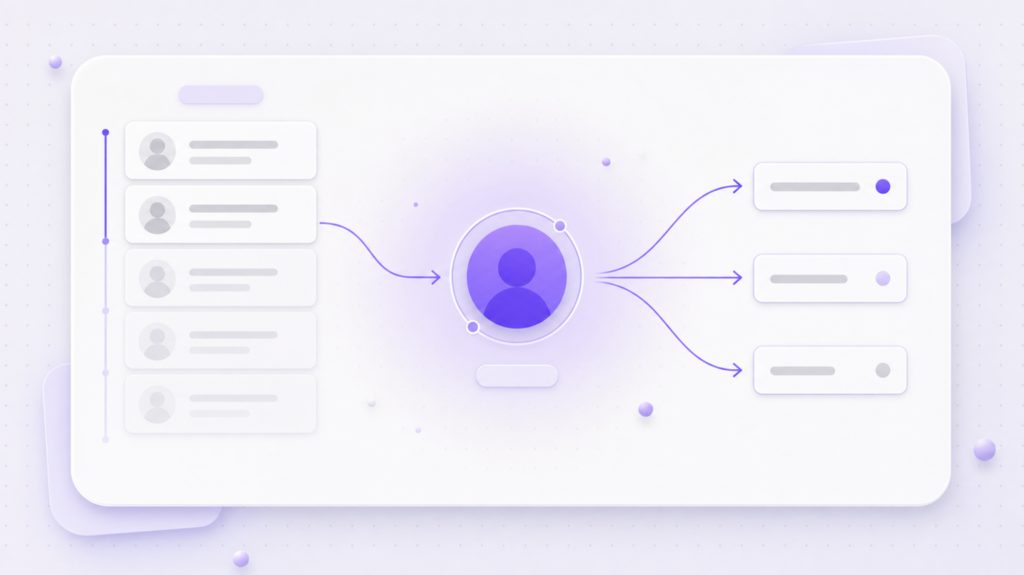
Live chat is a rota. That is the part the comparison articles skip past, because they are written for readers who solved it years ago and no longer think about it.
Comm100, which publishes an annual live chat benchmark study, reported that agents handled an average of 1,023 chats per agent per month in 2022, up from 714 the year before and 480 the year before that. That is not a widget setting. That is a job, with a shift pattern and a salary attached. The reason average wait time in that same dataset sat around thirty seconds is that somebody was rostered to make it thirty seconds.
Now ask what happens to those numbers when the person answering chats is also the person doing the fillings, packing the orders or writing the proposals. Wait time is no longer thirty seconds. It becomes however long it takes for that person to notice, which on a busy day is never.
The honest version of the question is not which tool is better. It is which of these two resources you can actually supply: staffed hours, or website content good enough to answer from.
Chatbot vs live chat, compared on what each one demands
| What it demands | Chatbot | Live chat |
|---|---|---|
| What it consumes | Website content that is accurate and reasonably complete | Staffed human hours, during published hours |
| What breaks it | Thin, outdated or contradictory pages. It cannot answer what is not written down anywhere | Nobody watching. The queue simply grows |
| First response | Immediate, and identical at 03:00 and 15:00 | As fast as your rota, unpredictable outside it |
| Coverage | Every hour your site is online | The hours you can pay someone to be present |
| Cost driver | Setup and content quality, then broadly flat as volume rises | Headcount. It rises in steps with concurrent conversations |
| Concurrency | Unlimited in practice. Traffic spikes cost almost nothing | One agent handles a handful at once before quality drops |
| Consistency | The same answer to the same question, every time | Varies by agent, by mood, by how late in the shift it is |
| Best at | Repeat questions with a documented answer, qualification, routing, after-hours capture | Judgement, negotiation, complaints, anything where being heard matters more than being answered |
| Worst at | Anything needing discretion or information that exists only in someone’s head | Answering the same three questions two hundred times a month without resentment |
| Failure looks like | A confident wrong answer, or an unhelpful “I do not know” | Silence, then an apologetic email two days later |
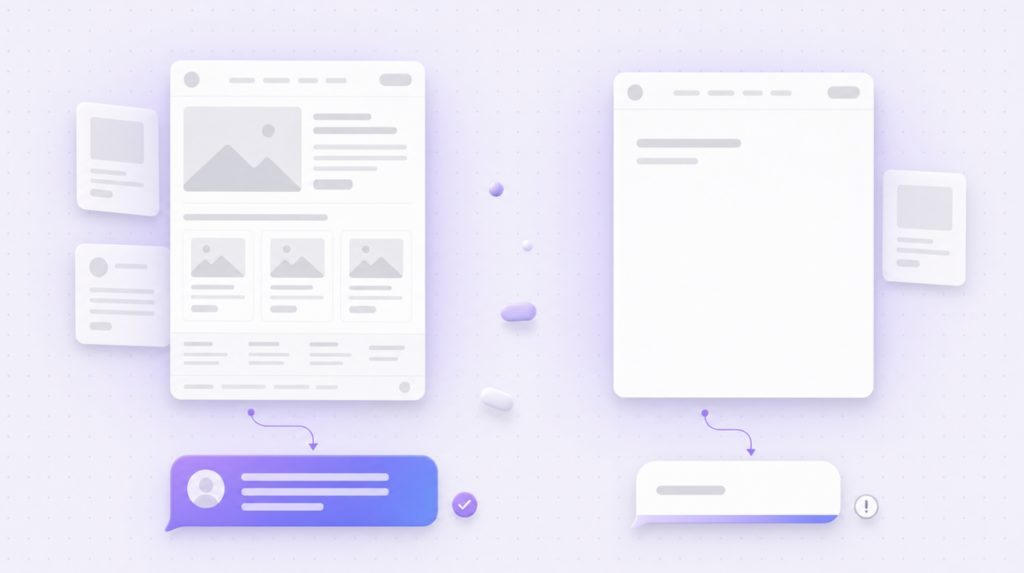
The row that decides it for most small businesses is the second one. A chatbot’s ceiling is set by your website, so if your pages do not state your delivery times, no chatbot will invent them correctly. That is a real prerequisite rather than a detail, and it is worth checking before you commission anything.
When live chat is genuinely the better choice
Live chat earns its cost in four situations, and it is worth saying so plainly rather than pretending automation wins everywhere. If any of the following describes the bulk of your enquiries, a chatbot is the wrong lead channel no matter how cheap it looks on paper.
The first is a high-value considered purchase where the conversation is the sale. If your average contract is meaningful and buyers arrive with objections that need handling, a human closing in real time is not a cost centre. It is the sales function with a chat interface on it.
The second is a complaint, or anything else emotionally loaded. Someone whose order arrived broken the day before an event does not want an accurate answer, they want a person to acknowledge it. Automating that moment reads as contempt, and you will see the result in your reviews rather than in your support metrics.
The third is regulated or high-stakes advice. Medical, legal and financial specifics should come from a qualified human, and the compliance exposure of getting that wrong dwarfs the labour cost of getting it right.
The fourth is simply that you already have the team. If someone is already paid to be reachable during business hours, live chat costs you almost nothing extra and gives you a channel that converts better than a form. Two or more of those describing your business is a clear signal to staff a live chat and stop reading comparison articles.
When a chatbot is the better choice
A chatbot wins on the shape of your question volume rather than on any general superiority over humans. The test is not how clever the software is, it is how much of your inbound traffic asks something you have already answered in writing.
It wins when the same handful of questions arrive constantly and the answers are stable and already published. Opening hours, what is included, whether you cover a particular area, how long delivery takes, whether a service suits a specific case. Those cost a human real time every single day and cost a chatbot nothing.
It wins outside business hours, which for most websites is the majority of the week. A visitor at 22:00 on a Saturday either gets an answer or leaves, and a chatbot at least captures the enquiry while the visitor is still on the page rather than losing it silently.
It wins across languages. Covering four languages with humans means four hires or an agency retainer, while covering four languages with automation means setting the tone and language per bot and letting it answer from content it has already learned.
And it wins when your realistic alternative is not live chat at all. For most small sites the true comparison is against a contact form nobody fills in, or a phone number nobody rings.
The cost numbers on other comparisons do not survive scrutiny
This one is worth flagging, because it will distort your budget if you trust what you read. Cost per interaction is the single most quoted figure on this topic and the least reliable.
ChatbotGen puts live chat at roughly one to three dollars per interaction. Layer3Labs puts it at ten to twenty-five. ChatSpark puts it at five to twenty-five. That is a twenty-five-fold spread on the same metric, published in the same period, mostly by companies that sell chatbots.
The spread exists because cost per interaction is not a property of the channel at all. It is your wage bill divided by your chat volume, and both of those numbers belong to you rather than to the industry. Ten minutes with your own figures will beat every published range, and the calculation is simple enough to do on paper.
Take the loaded hourly cost of whoever would answer chats, multiply it by the hours you need them present, then divide by the enquiries you actually receive in those hours. Compare that annual total against a one-off build plus running costs. That is the real comparison, and it is specific to your business rather than to the category.
The failure mode nobody warns you about
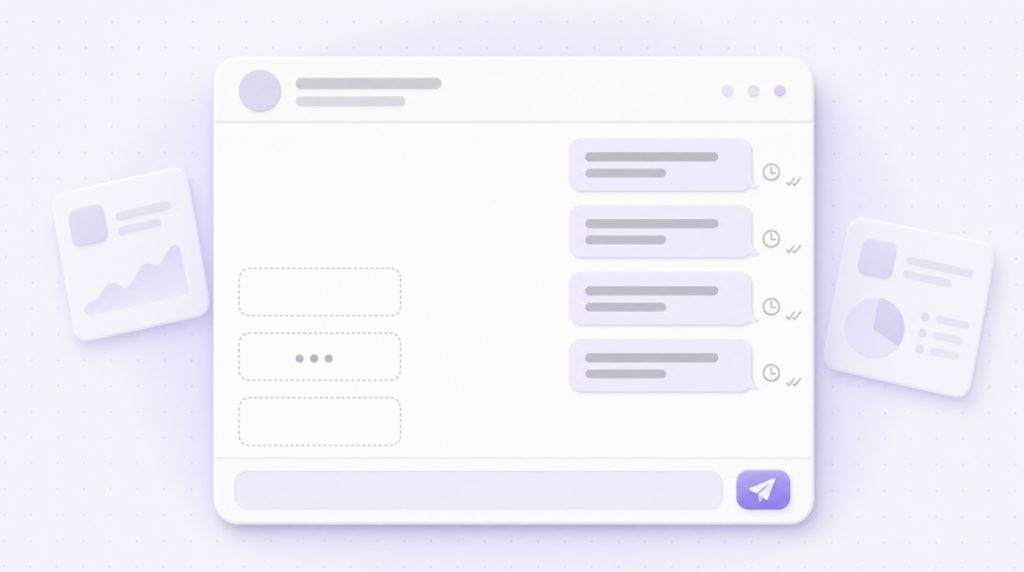
An unstaffed live chat widget is worse than no widget at all. That sounds like an exaggeration until you look at what each option promises the visitor.
A contact form makes an honest promise, which is that you will reply eventually. A live chat bubble makes a completely different promise, that somebody is present right now, so a visitor who types into it and gets nothing has been actively misled. They do not conclude that your team is busy. They conclude the site is abandoned and go somewhere that answers.
This is the most common version of the mistake in practice. A small business installs live chat with genuine intent, answers diligently for two weeks, gets busy, and leaves a silent widget running for a year. Every visitor who tries it converts worse than if the bubble had never existed, so if you cannot commit to a rota, the choice is not between chatbot and live chat. It is between a chatbot and nothing at all.
Do you need both?
Eventually, probably. The pattern that works is a chatbot on first touch handling the documented and repetitive questions, escalating to a human when it hits judgement, negotiation or a complaint.
Comm100’s 2026 benchmark, drawn from over 220 million live chat interactions across eighteen industries, put satisfaction on chatbot-to-agent handoffs at 92.6 percent. That figure suggests visitors do not object to starting with a bot, provided the handoff genuinely works when they need it. The objection is to being trapped with one.
Be clear about the trade-off before you commit to it. A hybrid setup still requires the staffed hours you were trying to avoid, just fewer of them, so it is a way to make a support team affordable rather than a way to skip having one. If you have no team and no plans for one, run the chatbot alone and route the hard cases to email where an asynchronous reply is an honest promise.
The verdict, by situation
| Your situation | Choose |
|---|---|
| No support staff, questions repeat, answers are on your site | Chatbot |
| No support staff, questions need judgement or discretion | Neither. Fix your contact page and answer by email |
| Existing team, mostly complex or high-value conversations | Live chat |
| Existing team drowning in repeat questions | Chatbot first, human escalation behind it |
| Multiple languages, one location, small team | Chatbot |
| Regulated advice as the core of the enquiry | Live chat, with a chatbot only for logistics questions |
TonePilot AI builds the chatbot side of this. It learns your existing site content, answers by text or voice, and captures the enquiry when there is nobody available to take it. If you want to know whether your site has enough content to support one, and what setting it up would involve, email hello@tonepilotai.com for a plan, a timeline and a quote. If the honest answer is that you should staff a live chat instead, we will tell you that.
The verdict, by situation
Can a chatbot hand a conversation over to a live person?
Yes, and the useful ones do it automatically once the question involves judgement, money or a complaint. What matters is where the escalation lands, because routing it to an unstaffed chat queue just builds a slower dead end.
Will a chatbot make things worse if my website content is thin?
It will cap what the chatbot can do, since it can only answer from what it has been given to read. A bot pointed at a five-page site with no delivery information cannot answer delivery questions, and one that guesses instead of admitting the gap will cost you more trust than it earns. The fix is not a better model but writing the missing answers down somewhere on your site first, which is work worth doing regardless of whether you ever install a chatbot.
Is live chat still worth it if I can only staff it a few hours a day?
Only if you publish those hours on the widget and it genuinely goes offline outside them. Part-time live chat that still looks available at midnight produces exactly the misleading experience that costs conversions.
How do I work out which one is cheaper for my site?
Ignore the per-interaction figures in comparison articles, since they vary by more than twenty times between sources and mostly come from vendors. Use your own inputs instead: the loaded hourly cost of whoever would answer, the hours you need them present, and the enquiries you actually receive in those hours. Compare that annual figure against a one-off build plus running costs and the answer usually stops being ambiguous.